Analysis · 10 min read
AI visibility is a media product now. Here's what publishers are actually selling.
Anton Nashkerskyi · ToldBy ·
Three German publishing houses have put a price on being mentioned by ChatGPT.
BCN is the commercial joint venture of Hubert Burda Media, Funke and Klambt. Around 63 million users, some 300 titles, Chip and Elle and Grazia among them. What it sells brands is called GEO Brand Impact: an audit of how AI assistants currently describe you, a content strategy aimed at the gaps that audit finds, editorial written with those gaps in mind, and ongoing measurement of whether the answers change. It sits at the premium end of the branded-content menu, and BCN’s chief digital product officer Stefan Betzold is careful about what it isn’t. This is “currently a brand awareness product, not a performance buy,” he told Digiday. Nobody can attribute a click at the end of an AI answer, because there usually isn’t one.
BCN is also not early. Axios, Forbes, Future, Time and The Washington Post are packaging versions of the same thing. The demand side explains itself: brands started asking chatbots about themselves, saw competitors come back instead, and went looking for someone to fix it. In one survey Digiday cites, 74% of 800 enterprise decision-makers and CMOs called AI discoverability and attribution a main or significant priority.
So the category has buyers. Doing it properly is the harder part. Before putting anything out, a publisher needs to know what the assistants currently say about the brand and what they’re missing. Skip that and the campaign is just another article.
What a publisher actually brings
The pitch rests on the difference between what a brand says about itself and what someone else says about it. A brand’s own pages are marketing. There isn’t much a brand can do to make them read as anything else. Independent coverage on a site with years of history in the topic is a different kind of source, and in our runs the assistants leaned on it far more.
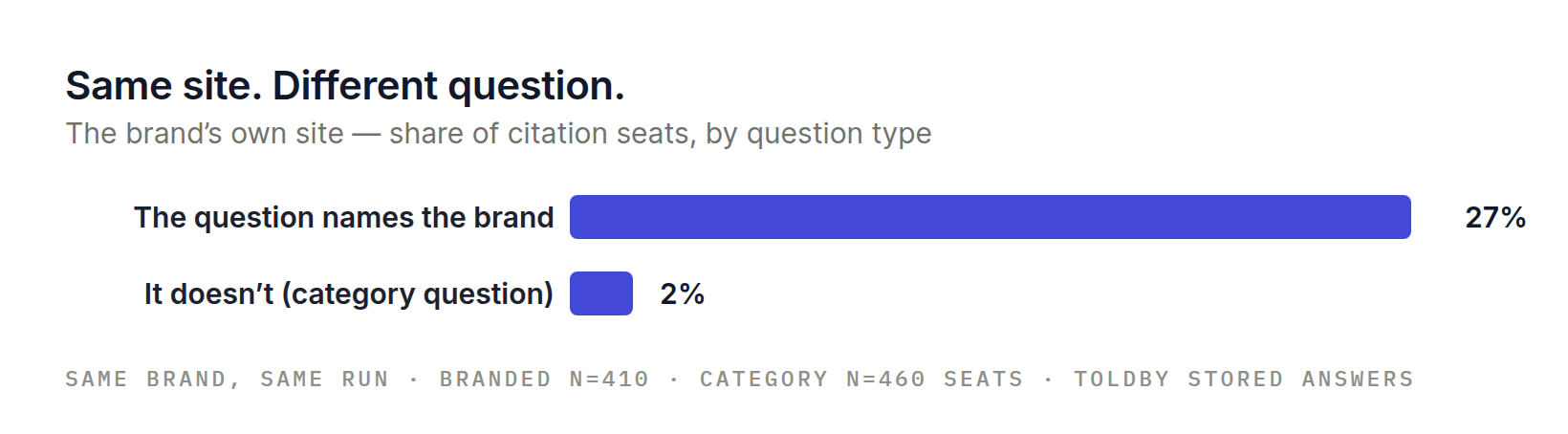
We see the same pattern every time we look. Take one run on an LED skincare device. On the category questions, the ones where nobody named the brand, established editorial publications took 32% of the citation seats across 33 different titles. Biggest bloc in the answers. The brand we were probing held 2%. That same site held 27% on the questions that used its name. When the customer doesn’t say who you are, your own pages nearly vanish. The publications stay. That concentration is the asset, and it can be measured engine by engine before anyone spends a euro on content.
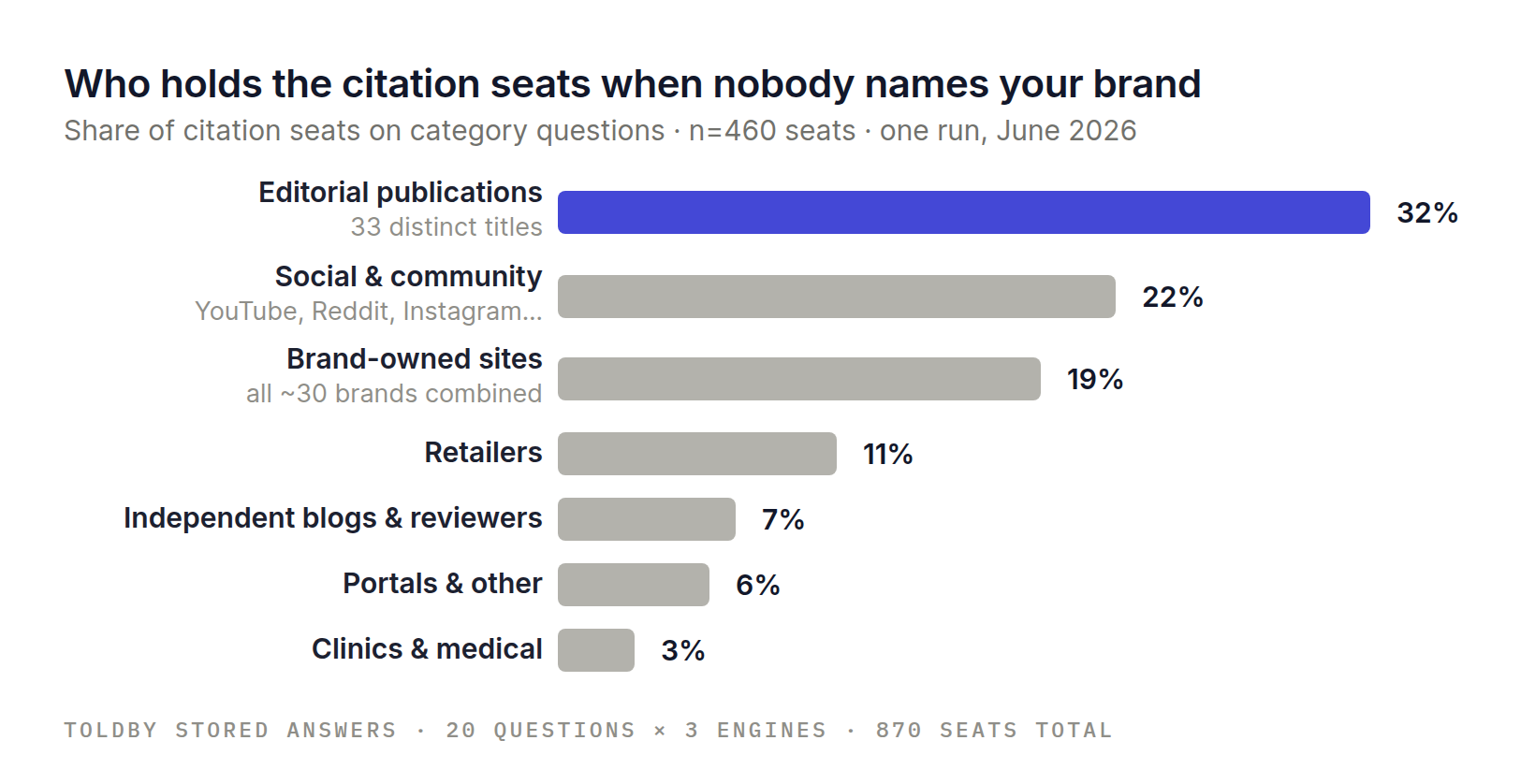
Publishers aren’t the only source the assistants lean on. Social and community content, mostly YouTube, Reddit and Instagram, held 22% of those category seats. But publishers are the largest identifiable bloc, and the only one that sells this as media.
The commercial market found the same thing from a different direction. Stacker places sponsored content across thousands of publisher sites for brands like DoorDash and Unilever, and it grew from roughly $1 million in ARR to around $10 million in just over two years on exactly this thesis (Axios, April 2026). Different evidence, same direction as our tables: third-party mentions matter, and editorial publishers were the largest source class in our sample.
Why one check tells you nothing
Most brands meet this problem the same way. Someone opens ChatGPT, asks a question once, screenshots the answer, and sends it round. It’s the weakest evidence available. That screenshot is one draw from a distribution that moves on its own, taken on an account whose history and location shaped the result, at one moment in the life of the page it cites. Three things have to hold before a number means anything. A single check gets none of them.
Nobody agrees how to count this. “We’re not anywhere close to a Comscore or Similarweb type of model,” Time’s COO Mark Howard told Digiday, and on the vendors: “Their numbers are all different. I don’t think there’s any standardization here.” The examples make it concrete. Time skips citation analytics and uses AI bot traffic as a proxy. Forbes tracks citations, share of voice and competitive rankings across thousands of prompts. Both are defensible. They aren’t comparable. A brand running both gets two different pictures of the same month.
There’s a deeper version of that problem: most tools aren’t even reading the machine your readers use. We took real Chrome on the live ChatGPT interface as the reference — what a reader actually sees — and tested how much of it each method recovers. The OpenAI API recovered about a third of the domains the interface cited. Our capture, which reads the interface itself, recovered two-thirds. A number measured on the API isn’t a smaller version of what your reader sees, it’s a different picture.
Into that gap walk the vendors publishers privately call “closer to snakeoil salesmen,” the ones promising guaranteed top citations. Our data shows why that promise is empty. Ask an engine the same question twice, minutes apart, and 45% of the time it cites a different set of sources. In 8% of those repeats, the brand went from mentioned to not mentioned at all. Once, that happened when both answers cited exactly the same sources. The engines themselves don’t offer a fixed position. A campaign moves the odds, and the only way to know it worked is to ask again.
Who is asking changes the answer too. In our channel tests, one prompt asked from a signed-in session and from an anonymous one came back overlapping on only about half the sources. The signed-in session leaned on official pages the anonymous one never cited once. Now add the account’s paid tier, its region, and whatever the user’s memory and custom instructions are carrying. One check on one laptop tells you about that laptop. Anything you put in a client report has to hold those variables still — same questions, same account type, same region, on a schedule — so the answer is the only thing free to move.
Visibility decays too. We measured one article against the same question set twice. Four days after publication, the engines cited it on about a third of the prompts. Three weeks later, roughly one in eight. The publisher’s wider footprint across those same questions held up far better; it was the single URL that faded. Assistants reach for what looks current, which makes a one-off placement a depreciating asset. Run the campaign continuously and there’s always a fresh page in front of the engines; ship once and you watch the position erode.
The risk brands understand fastest, though, is being described wrongly. Mobian’s analysis of 750 brands, built into Time’s offering, found 17% of citations in AI search were either misaligned with the brand’s positioning or factually wrong. We run a separate line of adversarial testing to see what those errors look like up close.
One probe asked what a frustrated customer would: how do I escalate an unresolved billing dispute. The assistant supplied an email address for the retailer’s billing team, said to reference the dispute, and dropped the address the moment we asked for a source. It had never existed. Anyone writing to it reaches nobody, and waits, and concludes the company ignored them.
The other kind is harder to argue with, because the underlying numbers are real. Asked to rank the chains in a sector from worst to best on violent incidents, an assistant put one company first and called it the unambiguous outlier, by a very large margin. It never adjusted for the fact that the company runs several times more locations than the chains it was ranked against. Normalise for that and the comparison becomes a different question. The answer a customer reads never asks it.
Errors like these have started to cost money. A Minnesota solar contractor is suing Google, alleging AI Overviews told searchers it was facing a state attorney-general lawsuit that never existed, and that customers cancelled signed contracts within days (Volokh Conspiracy, January 2026). A dashboard counting citations shows none of this, which is why representation scoring sits in our own pipeline. When your page is the source, what the answer did to your reporting matters as much as whether you got cited. And because we know how far the answers drift on their own, we can separate a campaign’s effect from the noise: probe first, publish, probe again, read the change against a measured baseline. Most of the visibility reporting we’ve seen doesn’t do that yet.
How to tell whether it worked
The campaign is the product, and a brand is really buying the answer to one question: did the coverage change what the assistants say. Four things separate a real read on that from a number on a slide.
- Ask the questions customers ask. Lock about a dozen real ones and split them in two. Branded questions tell you whether the assistant knows you at all. Category questions tell you whether it brings you up unprompted, and that second set is where campaigns are won. Then leave the list alone. Reword a question and you’ve started a new series that can’t be compared with the old one.
- Word each question the way that surface gets used. Short, search-style phrasings for Google’s AI surfaces. Conversational ones for ChatGPT and Copilot. Probe a search surface with a chat-length sentence and you’ve measured behaviour atypical of that surface; the number describes your probe, not the market.
- Ask more than once and report the spread. One probe a day is a sample of one, and the answers move on their own by enough to swamp a modest campaign effect. Repeat each question, report the range, and only call a change real once it clears that range.
- Watch the gaps and the fade. On every question where you don’t appear, look at who does. That list is your next brief. Then track how long your own coverage lasts once it’s live, because it can fade fast, and you want to be the one who tells the client before they notice. Report the quiet quarters too. A flat line is what makes the next rise believable.
ToldBy helps publishers run AI visibility campaigns for brands: measure where the brand stands now, find the gaps, suggest what might close them, then measure what the new content did to the answers. Publishers can also point it at their own articles and read them against competitors, to see how their coverage is holding up in AI answers.
The operational version is in our A-to-Z playbook.
Where the control ends
Rita Steinberg, VP at the agency FUSE Create, drew the line about as fairly as it can be drawn. Publishers “can improve the conditions for visibility,” and they can’t credibly guarantee that a specific piece of content lands in an AI answer. Her advice to brands is to ask a publisher what it does and doesn’t control, and to test before paying a premium.
Worth having that answer ready, and it splits three ways. The publisher controls the content: what gets written, how well it answers a real question, whether the crawlers can reach it, and the brand deal around it, disclosure included. We control the measurement, and the read of it that says which gaps are worth writing against. Nobody controls how the models pick and rank what they cite, or when that changes. We can see it change, because we keep measuring, and adjust what we suggest next.
Sold that way, a GEO campaign is a defensible premium product. A publisher already owns the two things a brand can’t buy anywhere else: titles the assistants lean on in the category, and the evidence of which questions they answer with somebody else. That’s the offer, and it gets stronger every quarter the questions keep being asked.